The Thirteenth Hand


Thirteen generations, one new domaine
The Girardin family has made wine in Burgundy since the seventeenth century. Pierre-Vincent is the thirteenth generation, and the son of Vincent Girardin, one of the best-known growers and négociants of the Côte de Beaune. When Vincent sold his domaine in the early 2010s, he kept back 4.5 hectares of his finest vines in Meursault, Pommard and Volnay, in case his son wanted them.
He did. Pierre-Vincent established his own domaine in Meursault at eighteen and made his first vintage in 2017. Those first wines were vinified in the family home; a new winery in Meursault followed. Long-term contracts with leading growers have since added names such as Puligny-Montrachet, Corton-Charlemagne, Bâtard-Montrachet and Montrachet itself to the inherited parcels.
The domaine holds a place in the Michelin Guide's main selection of Burgundy estates. Less than a decade after its first vintage, it is counted among the most sought-after young names of the Côte de Beaune.
- 13th · generation of the Girardin family in Burgundy
- 2017 · the first vintage, made at eighteen
- 4.5 ha · of inherited vines, the foundation of the domaine
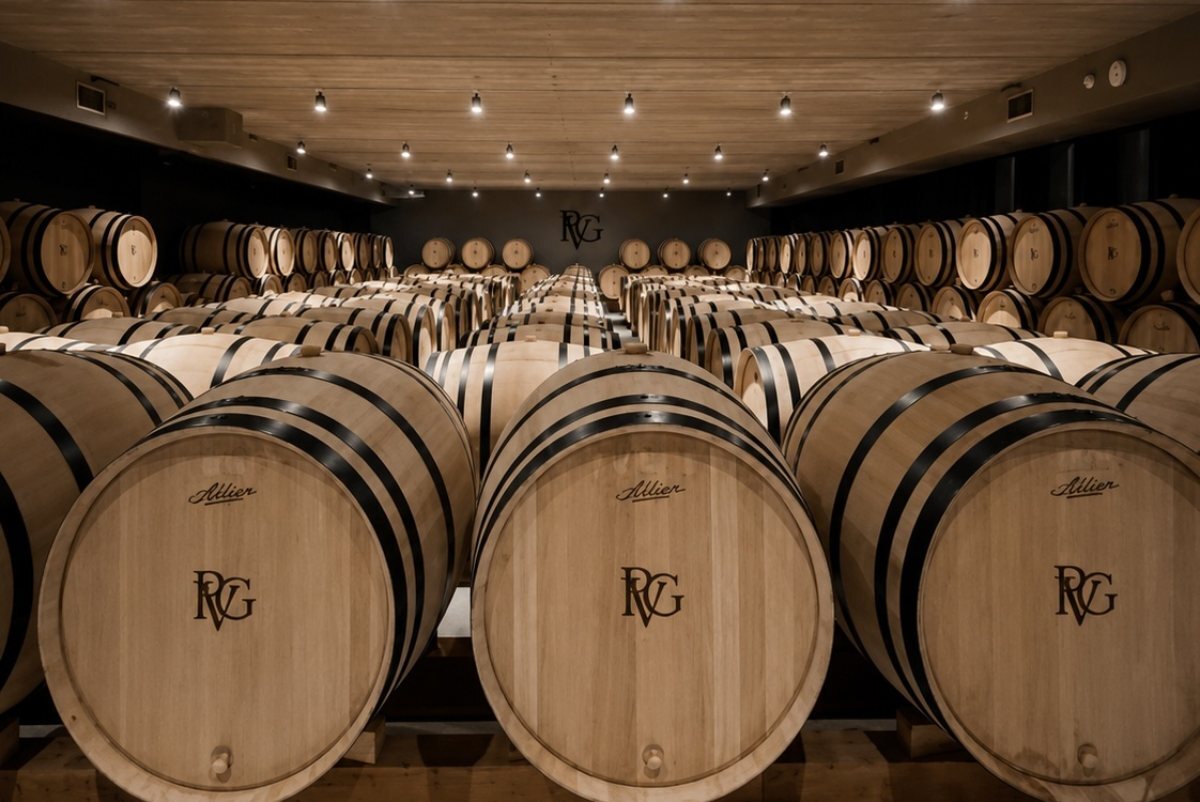
- 456 L · barrels for the whites, double the Burgundy standard
Less oak, more place
From the start Pierre-Vincent wanted wines that tasted of their site before their barrel. For the whites he had the cooperage François Frères build barrels of 456 litres, twice the size of the classic Burgundian pièce. The larger volume means less contact between wine and wood, and more room for minerality and freshness.
The reds are neither fined nor filtered, made to keep the silk of Pinot Noir intact. The winery is equipped with strict control of temperature and humidity, and with a laboratory he uses to put numbers on what he tastes.
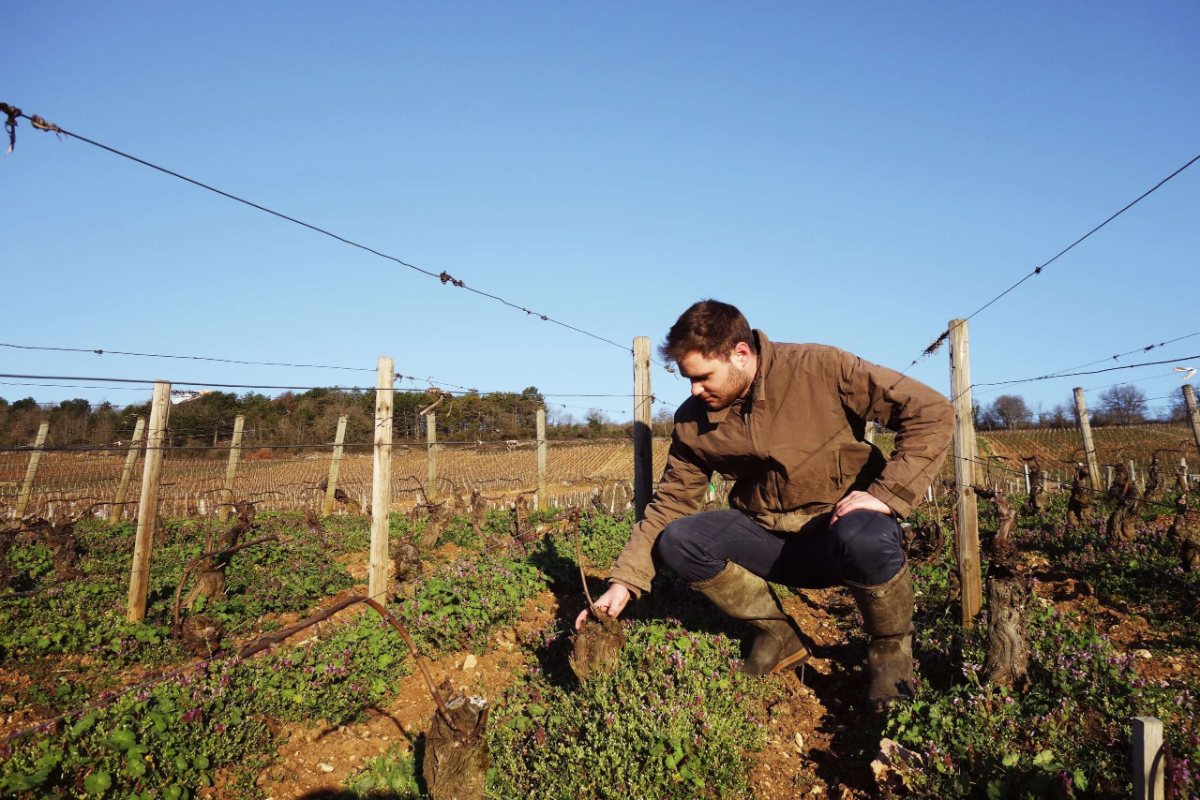
In the vineyard he works organically, largely with old vines. Since 2019 he has raised his canopies from 0.8 to 1.2 metres and trims the vines only once, at around 1.7 metres: more leaf to shade the fruit against heat, and less pressure from disease.
“I invested in a laboratory so I could translate my tastes and feelings into numbers.”
Pierre-Vincent Girardin
Tension before weight
Girardin's whites are defined by a few decisions taken early. He picks early, at the point where the fruit still has tension and freshness, rather than waiting for extra ripeness. He gives the grapes a long, firm pressing, which draws more from the skins and gives the wines grip and structure.
In the cellar the wines age in the 456-litre casks, with very little new oak. The result is a recognisable signature across the range: concentration, chalk and a firm line of acidity, with the oak in the background.
Across eight sites, the same method lets the differences of soil and slope come through: the salinity of Corton, the stone of Perrières, the breadth of Bâtard.
An early harvest, small berries
2025 began early and stayed early. Two heatwaves pushed ripening ahead, and harvest opened around 18 August, among the earliest starts on record. The first still-wine fruit of the Côte d'Or was picked in Meursault the following day. A cold front then brought around 100 mm of rain in a week from 27 August and split the harvest in two.
The heat and wind reduced the number of berries. What remained was small, thick-skinned and healthy, with fine concentration and almost no disease. Quantities are below average, and the Côte de Beaune made less white than in 2024. The Bourgogne Wine Board called it a vintage for the cellar.
For a grower who builds his wines on freshness, the year rewarded early, precise decisions. That is the balance members will find in these barrels: concentration from the small berries, tension from the limestone.

Meursault to Montrachet
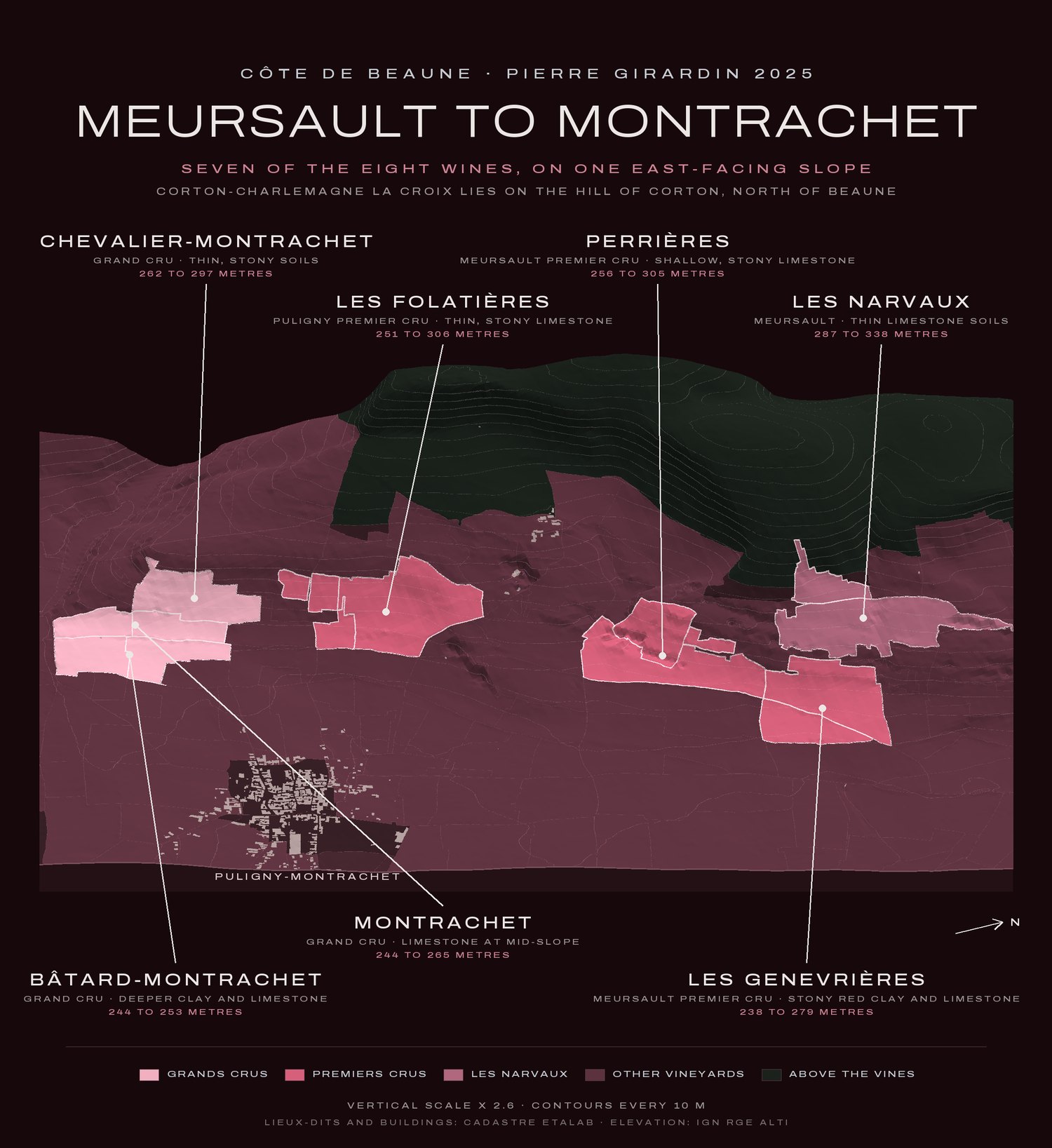
The 2025 range is eight whites. Four come from the grands crus of the Côte de Beaune, Montrachet and its neighbours on the Puligny–Chassagne slope and the hill of Corton. Four come from Meursault, where the domaine is based, and from Puligny. All eight are made the same way, so what changes from one glass to the next is the site.
Montrachet Grand Cru 2025 · Puligny / Chassagne
Barely eight hectares at mid-slope between Puligny and Chassagne, south-east on limestone. Power and finesse together: ripe citrus, toasted hazelnut, a deep mineral core. Reserve →
Chevalier-Montrachet Grand Cru 2025 · Puligny
The highest Grand Cru of Puligny, on thin, stony soils just above Montrachet. Intense without weight: white flowers, citrus oil, chalk and a very long finish. Reserve →
Bâtard-Montrachet Grand Cru 2025 · Puligny / Chassagne
Just below Montrachet, on deeper clay and limestone. The broadest and most powerful of the Grands Crus: orchard fruit, hazelnut and honey over a firm frame. Reserve →
Corton-Charlemagne Grand Cru La Croix 2025 · Hill of Corton
A named parcel on the pale marl and limestone of the hill of Corton. Stony and saline, with citrus, green apple, a touch of flint and a long, firm finish. Reserve →
Meursault 1er Cru Perrières 2025 · Meursault
The leading Premier Cru of Meursault, on shallow, stony limestone at the top of the slope. The most mineral wine of the village: citrus, crushed stone and great length. Reserve →
Meursault 1er Cru Les Genevrières 2025 · Meursault
East-facing, on stony, reddish clay and limestone. The most aromatic and finely textured of the Meursault crus: ripe peach, hazelnut, spice and a clear mineral finish. Reserve →
Puligny-Montrachet 1er Cru Les Folatières 2025 · Puligny
The largest Premier Cru of Puligny, high on the east-facing slope, on thin, stony limestone that gives line and precision. Reserve →
Meursault Les Narvaux 2025 · Village lieu-dit
One of the highest lieux-dits of Meursault, set above the Premiers Crus on thin limestone soils that bring tension and freshness. Reserve →
A young name, a short vintage
Burgundy has now had three small harvests in five years, and 2025 made less white in the Côte de Beaune than 2024. Supply from the most sought-after domaines tightens each year, and the young growers who reached the top quickly are often the hardest to find.
Girardin belongs to that group. His wines are built on freshness and site rather than oak and weight, the style that tends to reward patience in the cellar. Reserving in barrel, directly from the domaine, is the most reliable way to secure them.
Before the bottle
These wines are still in barrel in Meursault. Members reserve them now, from the domaine, before bottling and before they reach the wider market. Each bottle is then tracked from the cellar to the member's account, with its provenance recorded at every step.
Pierre Girardin, Barrels 2025, available to members on Crurated, released directly by the domaine.