The Sacred Stone


A man between two lands
In 1970 Arturo Pérez Rojas, an agronomist and oenologist born in Santiago, became Chile's first Secretary of State for Viticulture, a post created by the newly elected Salvador Allende. He led the first reforms to protect and develop the country's vineyards. In March 1973 Pablo Neruda wrote to him to say that, for the first time, Chilean wine was being taken seriously.
Six months later Allende was dead and Pinochet held power. Neruda died twelve days after the coup. Pérez Rojas, his wife Tela and their four children, Arturo, Marcela, Lorena and Marco, left for France. They expected to stay a short while. They stayed for decades.
In France his Chilean degrees counted for nothing. Some posts were closed to him because his qualifications were not recognised, others because he was overqualified. He went back to university and took new degrees in oenology and in economics, and spent thirty years learning the great French vineyards from the inside. The conviction that Chile could make wine to stand beside them never left him, and his children grew up with it.
The vine and wine are one of the essential riches of Chile.
Pablo Neruda to Arturo Pérez Rojas · 31 March 1973


A plot meant for a house
At the end of the millennium Tela's sister offered the couple a plot in Pirque, in the Maipo Valley, 50 kilometres south of Santiago. The idea was a house, a foothold in the country they had been forced to leave. Pérez Rojas walked the land and saw something else. Pirque, in the Maipo Andes, is the cradle of Chile's greatest wines, and this was a vein of 3.8 hectares he believed could produce one of the best in the world.
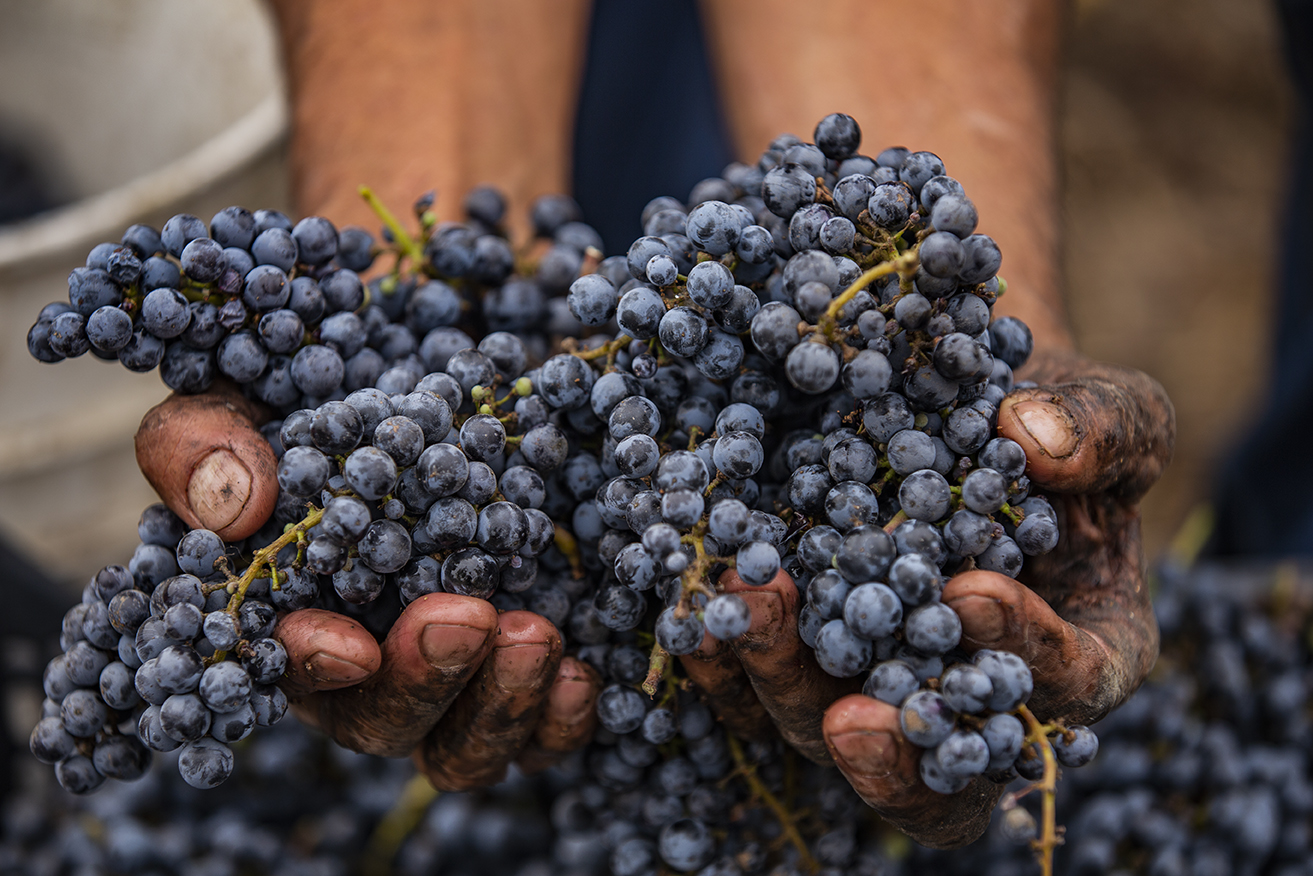
He planted in 2002. Every vine came from a massal selection of Cabernet Sauvignon, planted at high density on its own roots, with no rootstock. He laid drip irrigation fed by a deep well on the same land, so the vines would drink only the water of their own terroir, and sprinklers to protect them from frost. In the middle of the vineyard he built a tower, a nod to one of the most famous estates of Bordeaux and to the country that had taken his family in. It shows how high he set the bar.
The first grapes were picked in 2005 and sold to Concha y Toro. For nine years, without making a single drop of wine, he watched and learned. The vineyard was divided into seven plots by how each group of vines grew, ripened and tasted, and each began to be farmed on its own terms. Arturo Pérez Rojas died in 2013. The first vintage of Piedra Sagrada was 2014. He never tasted it.

An altar in the vineyard
In 2010, while the family was building its winery, the ground gave up a stone about two metres across, pierced by two perfect hollows. It is thought to be a piedra tacita, a sacred stone of the Amerindian peoples of central Chile, probably an altar for rites whose meaning is still poorly understood.
Indigenous communities across Chile are working today to have the cultural and spiritual value of these stones recognised, as objects rooted in the land and its living systems. The family chose to name the wine after it, and likes to think the stone lends the place a particular strength. Piedra sagrada means sacred stone.
- 3.8 ha · a single vein of ungrafted Cabernet Sauvignon
- 650 m · altitude, in the coldest corner of Pirque
- 30°C · the gap between day and night in the growing season
- 7 · micro-plots, each with its own soil and its own wine
An anomaly of nature
The site has been studied closely, and it still eludes a complete definition. Its cold, its water and its soils together produce a wine that the measurements do not explain. Piedra Sagrada embodies the beauty of ungrafted vines growing in an exceptional place, a place that has been described as an “anomaly of nature”.
The vineyard sits at 650 metres in the coldest part of Pirque, in what meteorologists call a cold spot. Spring and autumn frosts are severe. Summers are hot and dry, up to 37°C, winters short and cold with little rain, and with so little cloud the sun is strong all day. The swing between day and night can reach 30°C.
Below the plots runs an underground river that comes straight from the Andes. Together with the cold, it slows the grapes down and lets each plot ripen at its own pace. Harvesting 3.8 hectares often takes more than a month.
The soil is poor. The vines stand on the fourth and oldest terrace of an alluvial cone left by four glacial periods: a thin layer of silt low in organic matter, then, between 40 and 120 centimetres down, rounded glacial stones called bolones mixed with clay. Drainage is excellent and the roots go deep.
What sets this estate apart from its neighbours is that, within these 3.8 hectares, there are at least 12 different types of soil, divided into seven distinct plots. From the same grape variety they produce completely different wines: some with powerful, lingering tannins, others of great delicacy.

A promise kept by four children
When their father died, the children were offered the chance to sell. They refused. Arturo and Lorena are emergency physicians, Marcela is an architect and Marco a classical composer. None of them had made wine. Marco called a longtime friend, Éric Verdier.
Verdier is a taster and a specialist in classifying vineyard terroirs. At 21 he was one of forty tasters invited to assess the great Petrus vintages from 1926 to 1976, and placed second. Henri Jayer, Jean-Paul Gardère of Château Latour and Marcel Guigal have all written of his gifts. He confirmed what Pérez Rojas had seen in Pirque, and has worked with the family ever since. In the family's words, it is a spiritual dialogue with their father.
Marco signs each vintage as winemaker, with Alvaro Reyes overseeing the work on site. The siblings fly in from France for every harvest. They are now building the gravity-fed winery their father planned.


Key element
A great wine is made in the vineyard.
As Henri Jayer taught, to achieve greatness one must learn to step back and let the terroir speak.
When the work in the vineyard is complete, any intervention in the cellar only distorts.
Only then does the terroir reveal its true nature, and our ungrafted Cabernet Sauvignon become the pure vehicle for the character of this unique place.
In the cellar nothing is added: no yeast, no nutrients, no enzymes. Fermentation is spontaneous, carried by the yeasts of the vineyard itself, and the wine is not filtered. Verdier tastes the ferments of each plot, keeps only the best and sets the final blend, which goes into French oak barrels sourced from Burgundian cooperages (François Frères or Marsannay-le-Bois-du-Roi). The vintage decides how long it stays: 13 months in 2015, 42 in 2016. Whatever is not worthy of the year is declassified. Each wine is offered five years after bottling.
At Piedra Sagrada our role is simply to accompany the fruit from the vine. That, one might say, is the whole secret.
A profile on every bottle
Every label carries the profile of Arturo Pérez Rojas. On the white label, drawn by the illustrator Cédric Nagau, it wraps around the bottle so that he looks out at the Chilean coast, cut into the paper as a sharp, symbolic line. The pink label, by the artist Carlin Diaz, is a kaleidoscope of four of his profiles repeating to infinity, a tribute from his four children.
The two labels alternate from vintage to vintage. The choice says nothing about the wine inside.


Six years, six universes
With one variety and one vineyard, the difference between vintages is the year itself. The family describes each one as a world of its own, anchored by Piedra Sagrada’s signature essence: a flawless balance of acidity, tannin and alcohol that gives the wine its elegance.
2014 · The Origin · Harvest 7–8 May, by night · 2,346 bottles · 16 months
The first vintage, from a difficult year. Every bunch that was not ripe enough was removed. What remained gave a dark ruby wine of blackcurrant, blueberry, spice and incense, with no hardness on the palate.
2015 · The Classic · Harvest 18–20 April · 4,332 bottles · 13 months
Cabernet at its most opulent and dense, with the terroir melting the tannins into velvet. Red fruit, cedar, clove and a trace of violet.
2016 · The Legend · Torrential rain at harvest · 3,300 bottles · 42 months
Almost every bunch was sacrificed. Only one of the seven plots made it into the bottle, aged for three and a half years in mostly new oak. Bright ruby, velvety and long.
2017 · The Legacy · Harvest 3–6 April · 4,600 bottles · 16 months
A solar year and another drastic selection, but with fruit from all seven plots. Blueberry, blackcurrant, rare woods and spice, with fine, supple tannins.
2018 · The Tribute · Harvest 16–24 April · 8,984 bottles · 14 months
Dedicated to Arturo Pérez Rojas. A classic, straight Cabernet built for the cellar, with black fruit, spice and a fiery edge of raspberry.
2021 · The Vision · Harvest 1–20 April · 10,182 bottles · 22 months
After two years of silence, 2021 marks Piedra Sagrada's return. The largest vintage so far. Deep ruby with violet glints, blackberry, cedar, incense and wild strawberry, and tannins rich yet silken. Ready from 2026, at its peak from 2030.
2022 is next.
A grand cru without the noise
Piedra Sagrada has made between 2,346 and 10,182 bottles a year, and declassifies any lot that falls short. When necessary it sacrifices an entire vintage, as it did in 2019 and 2020.
As Lewis Chester puts it, “Piedra Sagrada is a 100% Cabernet Sauvignon that defies Cabernet convention, insisting on tasting first and foremost of the place it comes from.”
In December 2025 Decanter called it Chile's new grand cru and one of the most memorable of more than 1,200 wines it tasted that year. It is still largely unknown to the wider market.
It is also one family's answer to history: a wine planted by a man forced out of his country, finished by children who would not let the land go. In fifteen years, these are the vintages that will show what Pirque could do.
Piedra Sagrada, available to members on Crurated, released directly by the family.